Rights of Nature Guide
Rights for Nature: Guide Coming Soon
Resources
We’re building out our resources to help you find your way to connecting your local work with the larger movements that can support local river and ecosystem stewardship.
-
Join EU ECI & ECI (Ireland) over 16 countries across the EU project to promote the European Citizens Initiative for Rights for Nature. The "Rights for Nature: Empower Citizens to Represent and Protect Ecosystems" is an official European Citizens' Initiative (ECI) registered by the European Commission on May 19, 2026. It urges the EU to pass laws recognizing ecosystems as living entities with fundamental rights rather than mere property. The ECI campaign will be launched on Oct 13th
The details are set out here: https://rightsfornature.eu/
-
-
RIVER CHARTERS -
River Charters are a way of recognising rivers as living ecosystems that deserve care and representation - they are a turning point in how we value, respect and represent nature.
River charters don't necessarily grant legal rights…yet. But they are changing how we think about nature.
River Charters help to establish:
the right to representation and advocacy, (new positions on local councils etc can be created specifically to speak for the river in decision-making)
to exist naturally,
to flow sustainably,
to be free from pollution,
to biodiversity integrity,
to community connection,
and to regeneration and restoration.
All life depends on our rivers, we too are made of water, we know that rivers are our lifeblood. They are vital to our health, well-being, culture, heritage, living ecosystems and livelihoods. They also play a critical role in arresting and adapting to the climate and biodiversity crisis.
Yet today they face multiple threats from pollution, extraction, dredging, development, industry and conventional farming. Many are toxified by agricultural run-off, waste water treatment plants and industrial waste. Some are clogged with garbage. Still others are dammed and diverted, decimating fish stocks and the communities that depend on them. That’s why a growing global movement is emerging to guarantee the fundamental Rights of Nature...and the Rights of Rivers in particular. By recognizing that rivers have fundamental rights, we can better assure their protection.
And we can begin to shift legal paradigms that allow our rivers, our most vital and sacred natural resources, to be exploited for the benefit of the few at the cost of the many.
Supported by environmental and social organisations, this initiative aims to transform the way legal systems relate to rivers: not merely as resources, but as living ecosystems with rights of their own.🌊🌊
Recognising rivers as subjects of rights could allow citizens to represent them and defend their interests when decisions affecting them are made. 💦💦
FAQ:
1) How Communities / Citizens can start change →
Working towards normalizing Rights of Nature and Rights for Rivers isn’t a singular strand of work. It is both grassroots up and from national and global leadership arcs meeting in the middle.
We decide what caring for nature means to each of us individually and in our immediate communities. It connects our respect for the inherent right for life to exist along with understanding we are not separate from but, in truth, a part of the web of life. When we realize this, we can think about our relationships within that web for our health, our quality of life, our long term economic and food security and what we want to leave as a legacy for our children, grandchildren and future generations.
Local communities can adopt a charter, articulate declarations and pass local legislation to enshrine care for our common home ‘at home’. These ideas can be integrated into management plans for open spaces, for park management, tidy towns, etc. The possibilities are only limited by your imagination! Even businesses have begun giving a seat to nature on their boards.
All this happens simultaneously as we work together on the national and international levels to for establishing and embracing both philosophical and legal frameworks to protect our world.
In Ireland a huge wave of support was generated for the movement under the Citizen’s Assembly on Biodiversity Loss 2023 with a recommendation for Irish Constitutional Change to include the Rights of Nature.
2) Knowing what Rights of Nature means →
It is the holistic recognition that all life, all ecosystems on our planet are deeply intertwined.
Rather than treating Nature as property under the law, Rights of Nature acknowledges that Nature in all its life forms has the right to exist, persist, maintain and regenerate its vital cycles.
And we – the people – have the legal authority and responsibility to enforce these rights on behalf of ecosystems. The ecosystem itself can be named as the injured party, with its own legal standing rights, in cases alleging rights violations.
For cultures around the world, recognizing the Rights of Nature is consistent with their traditions of living in harmony with Nature. All life, including human life, is deeply connected. Decisions and values are based on what is good for the whole.
Global Alliance for the Rights of Nature, GARN Global
3) Examples of a successful European precedent with Mar Menor and creative movements with UK Rivers →
There have been successful campaigns to establish Rights of Nature, and Rights of Rivers around the world from the Whanganui River in New Zealand to Mar Menor in Spain. We have new precedents being established every day.
UK River initiatives have leaned into the creative side of water protection to stir the imagination with movements like the Friends of the River Medway Pilgrimages, who have worked with Maidenstown Councils on the development and implementation of a rights of nature framework. Along side this the entire catchment of the River Wye has been formally recognised as a living ecosystem with intrinsic rights in a charter, the first in the UK that campaigners hope will help save a heavily polluted ecosystem on the verge of collapse. It incudes therigh to flow, to biodiversity to be free from pollution to be supported by a healthy catchment to regenerate and to be represented. Jackie Charlton, the county councils cabinet minister said “ the River Wye is central to our environment communities and heritage. By adopting this charter, we are making a clear statement that the river’s health matters and must be protected. This s about working together with partners and communities to restore the river and safeguard it for generations to come.”
Other River protectors in the UK have chosen a more creative approach such as those at the River Avon choosing to express their commitments by marrying their waterways!
Rights for Nature EU website has information about EU specific progress and the Citizen’s Initiative and can keep you informed as well as provide opportunities for you to get involved.
Some resources on the Rights of Nature in Ireland can be found in Women of the Water’sResources. Here you can find a compilation of articles and videos from Ireland North and South including great work by EJIN.
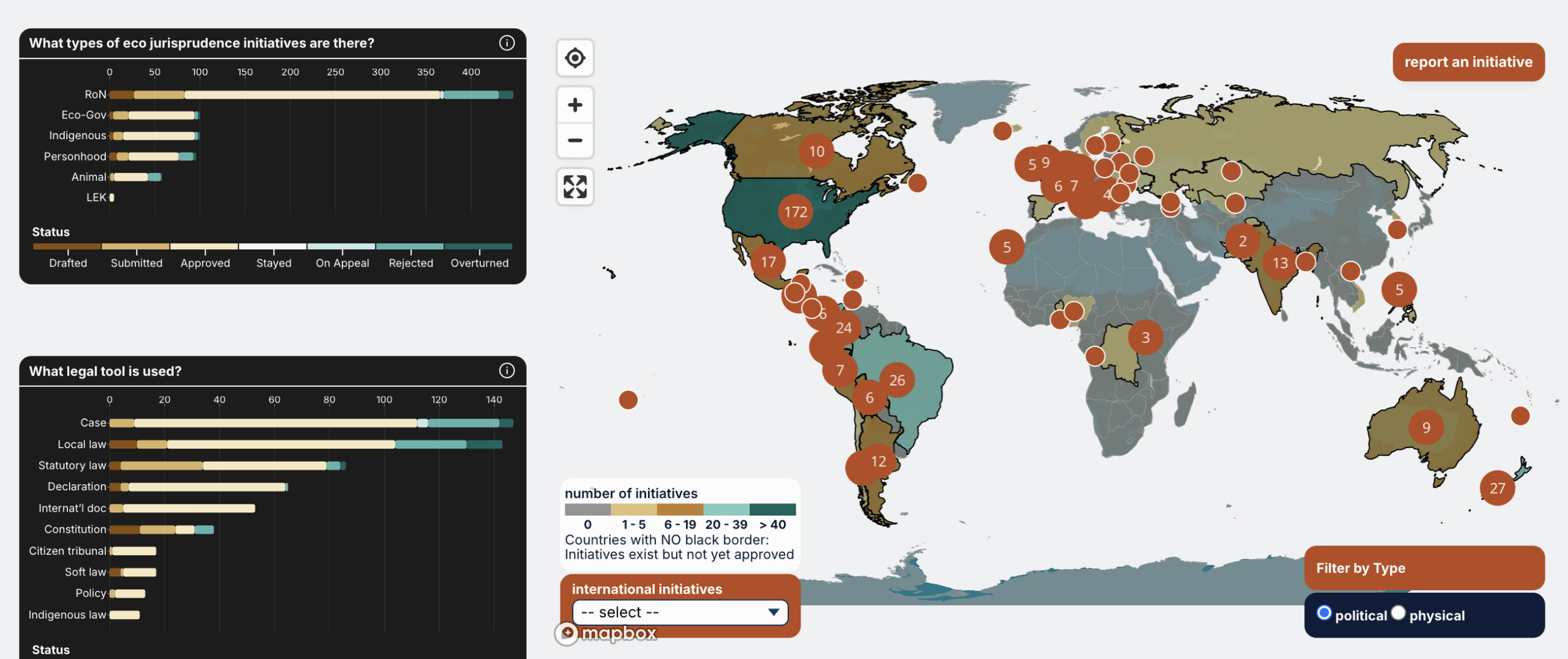
Check out GARN Globalto learn more about EcoJurisprudence around the world which you can see from their map below, is a full fledged movement growing every day.
4) Look for, learn about and participate in groups and organizations already doing the work or add your group to a broader network to strengthen our ability to achieve our goals and protect the places we love and which support our ability to thrive
Waterbodies EU - A solidarity network of 35+ grassroots initiatives developing new strategies for legal, political and cultural...
Your support helps advance this groundbreaking campaign and the global movement for the Rights of Nature.